The pain
Research, product, marketing and support live in separate conversations. Important assumptions remain untested.

THE VENTURE LAUNCH MODEL / VLM
Launch a business. Relaunch with purpose. Keep learning as you grow.
The Venture Launch Model (VLM) is Launchistry’s connected methodology for launching or relaunching businesses. It brings customer validation, product delivery, pilot testing, distribution and commercial health into one recurring learning cycle—with a Venture Captain coordinating the work.
By Launchistry · Framework guide · Updated October 26, 2026
THE PAIN / BUSY DOESN’T ALWAYS MEAN PROGRESS
A founder can have a working product, an enthusiastic team and a full task list—and still struggle to reach customers. Marketing waits for positioning. Development waits for requirements. Customers wait for answers. Everyone is working, but the handoffs keep breaking.
Research, product, marketing and support live in separate conversations. Important assumptions remain untested.
Teams build too much, promote too early or discover too late that customers need something different.
A connected operating rhythm gives the work an owner, makes dependencies visible and brings customer evidence into the next decision.
THE ARCHITECTURE / PEOPLE, PRODUCTS AND DISTRIBUTION
VLM connects three things that often drift apart: the portfolio’s direction, the people doing the work and the channels that reach customers. Each venture has a Captain who coordinates product, pilot, marketing, support and growth. Shared specialists contribute design, development, marketing, video and finance support. Portfolio leadership coordinates priorities and capacity across ventures.
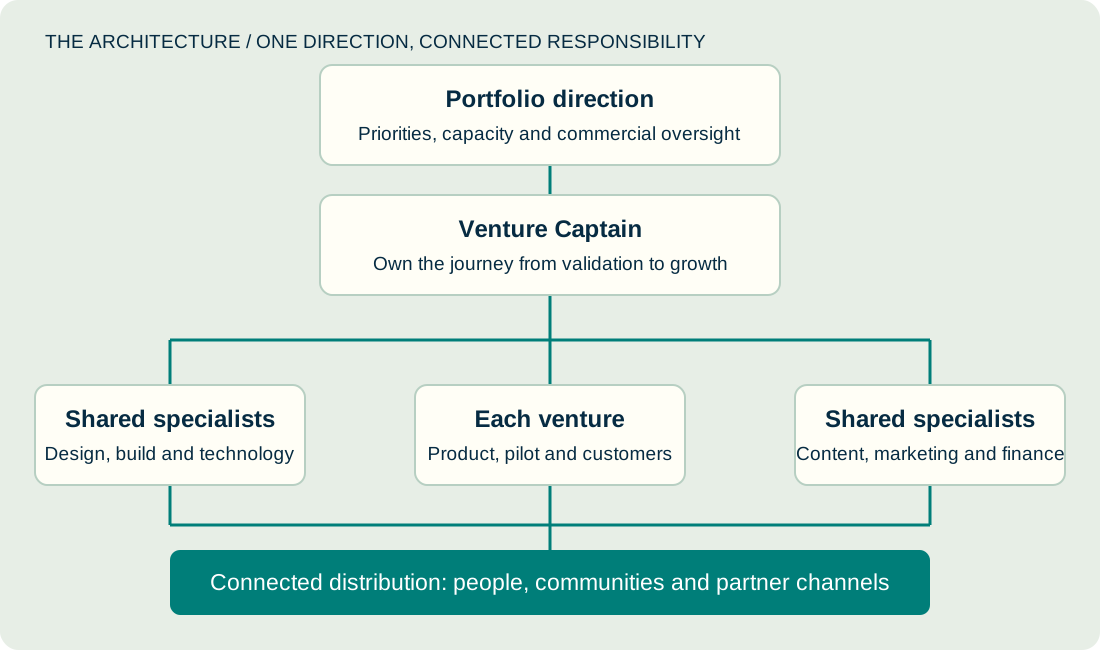
A product needs a route to people who care. A fictional portfolio might connect HarborCircle, a local services directory, with GatherLane, a community membership tool, and TradeNest, a business buying assistant. Their audiences and channels may offer relevant introductions or partnerships. Each connection still needs a clear customer fit and a measurable purpose.
All business and character names on this page are fictional. Examples explain the method; they are not customer case studies or reported results.
THE METHODOLOGY / ALL 17 WORKSTREAMS
The Venture Launch Model covers all 17 workstreams below. Each has a distinct purpose, a clear responsibility and evidence to bring into the next decision. They overlap and recur: content begins before promotion, commercial health matters before launch, and feedback can take you back to validation or planning.
The framework numbers the first 15 workstreams and identifies Legal & Compliance and People & Capacity as responsibilities across stages. For a complete reading guide, they appear here as 16 and 17. The numbering helps you navigate; it is not a requirement to finish one before starting another.
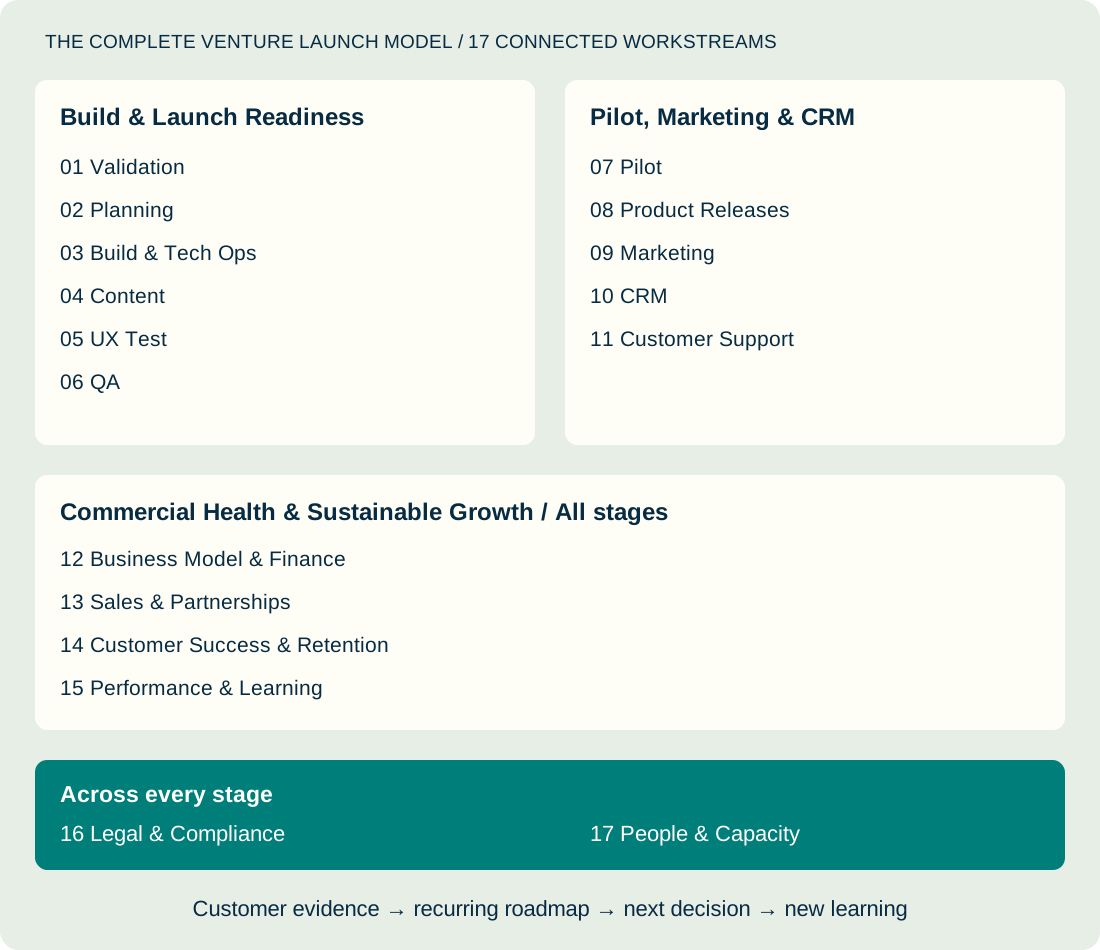
1–6 / Build & Launch Readiness
Understand the customer and prepare a usable, dependable offer.
Find the pain worth solving.
Pain and effect: A team falls in love with an idea before understanding the customer. The effect is a product built around assumptions.
What this workstream does: Research the pain and proposed solution, the market and competitors. Define the ideal customer profile (ICP), positioning and distribution strategy. Return to these assumptions when the evidence changes.
Fictional example: HarborCircle starts with busy families who need to compare local providers, rather than trying to serve every possible visitor.
What this produces: A defined customer, an evidence-backed problem and a testable market hypothesis.
Choose the next useful release.
Pain and effect: Every request feels urgent. The effect is growing scope, unclear requirements and a launch that keeps slipping.
What this workstream does: Prioritize the customer segment and feature set, write requirements, prototype the experience and develop the design. Maintain a recurring roadmap so customer evidence can change priorities.
Fictional example: Maya narrows HarborCircle’s first release to finding, comparing and contacting a provider. Extra features wait until the core journey has been tested.
What this produces: Reviewed scope, clear requirements and a roadmap the team can revisit.
Make the product dependable.
Pain and effect: A working demo can still be difficult to maintain or recover. An outage, access mistake or missing backup can interrupt the business.
What this workstream does: Develop and maintain the product. Review licenses; prepare hosting, backups, access, security, monitoring and recovery. Set up communication and support tools, and bring technical needs into the recurring roadmap.
Fictional example: HarborCircle’s team prepares backup and recovery arrangements and gives contributors the access needed for their roles before inviting customers.
What this produces: A working product with operational responsibility and readiness evidence.
Make the offer easy to understand.
Pain and effect: The product makes sense to its creators but leaves customers guessing. The effect is confusion about who it helps and what to do next.
What this workstream does: Iterate audience priorities and prepare messaging, search and AI discovery content, social accounts and communication templates. Create the logo, icons and favicon. Coordinate privacy information, terms and user agreements with Legal & Compliance.
Fictional example: HarborCircle explains how families compare providers and what happens after a contact request. Its pages and messages use the same plain language.
What this produces: Consistent, audience-appropriate assets with clear next steps and required reviews.
See where people get stuck.
Pain and effect: The team knows where every button is. A new user does not. Confusing journeys can stop people before they receive value.
What this workstream does: Test realistic journeys with users, app administrators and super administrators. Observe whether people understand the interface and can complete important tasks. Record findings and prioritize usability improvements.
Fictional example: An invited family finds a listing but cannot tell how to contact the provider. The team revises the journey and tries it again.
What this produces: Evidence that representative roles can complete critical journeys, with remaining usability issues recorded.
Check that the experience works.
Pain and effect: A clear-looking screen may still calculate, save or behave incorrectly. Defects can break customer trust and create repeat work.
What this workstream does: Use automated and manual testing for users, app administrators and super administrators. Check expected behavior, permissions and important journeys; record defects, run regression checks and review release evidence.
Fictional example: The team checks that HarborCircle contact requests reach the right destination and that one account cannot edit another provider’s listing.
What this produces: Passing critical acceptance checks and an explicit review of remaining defects.
7–11 / Pilot, Marketing & CRM
Test the experience, coordinate releases and connect with customers.
Learn with a smaller audience.
Pain and effect: A broad launch magnifies problems the team has not yet seen. The effect is more people encountering the same unresolved issue.
What this workstream does: Run widening rounds: internal users, invitees and then referrers. Consider relevant incentives such as free trials, posting credits or referral credits. Prepare affiliates, influencers and partners before broader promotion. Feed findings into the roadmap.
Fictional example: HarborCircle tests internally, invites a small group of families and then explores referrals once the contact journey is clearer.
What this produces: Pilot evidence and a reviewed decision about what is ready for wider use.
Turn the roadmap into controlled changes.
Pain and effect: Changes arrive without a shared scope or readiness decision. Customers and contributors struggle to know what changed and what to expect.
What this workstream does: Select release scope from the recurring roadmap, confirm readiness and coordinate rollout. Prepare release communication, check the experience after release and bring new findings into the next roadmap review.
Fictional example: HarborCircle ships the improved contact flow as a focused release and verifies it after rollout before adding the next feature.
What this produces: A defined release, readiness evidence and verified rollout.
Reach the people the offer is for.
Pain and effect: The team publishes everywhere but cannot tell which activity reaches useful prospects. Effort becomes disconnected from customer demand.
What this workstream does: Coordinate ICP-led inbound work: blogs, PR, social, videos, demos, podcasts, interviews, thought leadership, white papers and community. Combine it with relevant outbound work through clients, networks, LinkedIn, email, calls, paid ads and directories. Track distribution and channel performance.
Fictional example: HarborCircle tests a useful comparison guide and relevant community outreach, then reviews which channels bring people who actually use the directory.
What this produces: An audience-specific distribution plan with measurable channel performance.
Keep every relationship connected.
Pain and effect: An enquiry lands in one inbox and a promise lives in someone’s memory. Follow-ups get lost and the team cannot see the pipeline.
What this workstream does: Track contacts, opportunities, owners, follow-ups and outcomes. Keep reporting current so the next person can understand what happened and what needs attention.
Fictional example: A provider asks Maya about joining HarborCircle. The enquiry has an owner, a recorded next step and a follow-up date.
What this produces: A traceable pipeline with clear follow-up responsibility.
Give questions and problems a route to resolution.
Pain and effect: Customers ask for help but do not know where to go. Repeated issues consume time and unresolved problems weaken trust.
What this workstream does: Handle questions and issues, define triage and escalation, and maintain a knowledge base. Give issues accountable owners, verify resolution and feed recurring problems back into the roadmap.
Fictional example: When a HarborCircle provider cannot update a listing, support records the problem, escalates it when needed and confirms that the fix works.
What this produces: Clear support routes, owned issues and verified closure.
12–15 / Commercial Health & Sustainable Growth
Keep economics, commercial relationships and customer outcomes in view at every stage.
Make the numbers part of the plan.
Pain and effect: More activity or revenue can hide a business that costs too much to run. Cash needs and weak margins can surface late.
What this workstream does: Review pricing, packaging and unit economics alongside costs, budgets, cash requirements and margins. Make assumptions explicit and keep a path to sustained profitability in view throughout the venture’s life.
Fictional example: HarborCircle compares a proposed provider package with the cost of onboarding and supporting each provider before expanding promotion.
What this produces: Visible commercial assumptions, measured economics and an informed funding or pricing decision.
Turn interest into a useful commercial relationship.
Pain and effect: Interest does not automatically become a customer or a productive partnership. Unqualified leads and vague agreements absorb capacity.
What this workstream does: Qualify leads, run demos, prepare proposals and manage closing. Handle inbound sales through email, web and social channels. Develop referral and distribution partnerships, then review conversion and partner performance.
Fictional example: A fictional community organization considers introducing HarborCircle to its members. The team clarifies audience fit, responsibilities and how the relationship will be evaluated.
What this produces: An owned sales pipeline and partnerships with clear purposes and reviewable results.
Help customers keep receiving value.
Pain and effect: A customer signs up but never forms a useful habit. Weak onboarding or unmet expectations can lead to inactivity and churn.
What this workstream does: Guide onboarding, activation and adoption. Review customer outcomes, renewals and expansion opportunities. Watch churn signals, assign retention actions and report what customers are achieving.
Fictional example: For the fictional TradeNest buying tool, the team helps new buyers complete their first useful task and investigates why some do not return.
What this produces: Customer outcomes and retention risks with named owners and next actions.
Use evidence to choose the next move.
Pain and effect: A full dashboard can still leave the team unsure what to do. Without review, feedback and metrics never change the work.
What this workstream does: Review usage, outcomes and growth metrics alongside experiments and customer feedback. Ask what the evidence supports, what remains uncertain and what should change. Feed those decisions into the recurring roadmap.
Fictional example: HarborCircle reviews completed contact requests alongside visits. If visits rise but useful requests do not, the team investigates the journey before increasing promotion.
What this produces: Reviewed evidence that changes priorities and defines the next experiment.
16–17 / Responsibilities across every stage
Legal & Compliance and People & Capacity apply throughout. These are ongoing responsibilities, not final steps to postpone until after growth.
Keep obligations connected to everyday decisions.
Pain and effect: Privacy, contracts or licensing can fall between teams. Unclear ownership leaves required reviews and actions unfinished.
What this workstream does: Name an accountable owner for privacy, contracts, licensing and applicable obligations. Maintain the relevant reviews and actions throughout the venture, coordinating with Content, Build & Tech Ops and other workstreams.
Fictional example: Before HarborCircle changes what information it collects, the responsible reviewer checks the proposed use and updates the required actions and customer information.
What this produces: Recorded owners, reviews and actions for applicable obligations.
Make the plan fit the people available.
Pain and effect: Several ventures need the same specialist at the same time. Hidden capacity limits cause delays and broken handoffs.
What this workstream does: Coordinate owners, availability and specialist allocation across business units and the portfolio. Resolve competing priorities, handoffs and dependencies while keeping the Venture Captain’s responsibility clear.
Fictional example: HarborCircle and TradeNest both need design support. Portfolio leadership and the Captains agree priorities and availability before committing to release dates.
What this produces: Explicit allocation, visible capacity constraints and clear handoffs.
A FICTIONAL LAUNCH STORY / HARBORCIRCLE
Maya wants to build HarborCircle, a directory that helps people find local services. Her first plan serves everyone: families, professionals and service businesses. The team keeps adding filters. The launch date keeps moving.
In this illustrative scenario, conversations reveal a narrower need: busy families struggle to compare providers and understand how to make contact. The first release focuses on that journey.
The Captain coordinates a small prototype. Design makes comparison easier. Development tests listings and contact requests. Content explains who the directory serves. Support prepares answers to likely questions.
Internal testers try the journey before invited families do. Imagine that invitees can find a listing but hesitate to send a request. That feedback makes the next priority clearer: explain the contact process and improve the provider information before increasing promotion.
The team reviews activation, qualified enquiries, provider response and the cost of serving customers alongside pricing. The next release follows the evidence. The example illustrates a decision process, without implying a successful commercial result.
RELAUNCHING / FIND THE BREAK IN THE CHAIN
Consider TradeNest, a fictional business buying tool with sign-ups but little repeat use. A relaunch begins by asking where the experience loses value. Is it reaching the wrong buyers? Is the first useful action too difficult? Is the offer hard to understand? Does the pricing fit the outcome?
| What you observe | What to revisit | What to test next |
|---|---|---|
| People visit but do not enquire | Audience, positioning and offer | A clearer message for one customer segment |
| People sign up but never reach value | Onboarding, usability and activation | A simpler first useful action with invited users |
| Customers leave after early use | Customer outcomes, product fit and support | A focused improvement based on churn feedback |
| Revenue grows but cash stays tight | Pricing, cost to serve and margins | A revised package with explicit financial assumptions |
Choose the most important uncertainty, assign an owner and run a focused test. Re-enter the relevant VLM workstream, update the recurring roadmap and use a controlled pilot to learn before expanding again.
PUTTING IT TO WORK
The method provides direction; the day-to-day work needs a shared place to happen. Explore the Venture Command Center platform and how Launchistry connects context, people and execution.
COMMON QUESTIONS
The Venture Launch Model (VLM) is Launchistry’s connected methodology for launching or relaunching businesses. It brings validation, planning, product delivery, pilots, distribution, customer relationships and commercial health into one recurring learning cycle.
Yes. Begin with the point where progress has stalled: unclear positioning, weak activation, poor retention, an unreliable product or unsustainable economics. Revalidate that assumption, narrow the next release and test the change with a controlled pilot.
A Venture Captain coordinates the venture from product build and pilot through marketing, support and growth. Shared specialists contribute defined work, while portfolio leadership helps resolve capacity, priorities and dependencies.
No. Support, customer success, releases, financial reviews and performance learning continue after launch. Evidence from customers and channels feeds the recurring roadmap.
VLM describes the methodology: the responsibilities, workstreams and learning cycle. Venture Command Center is Launchistry’s workspace for connecting venture context, team conversations and execution.
No methodology guarantees demand, revenue or profitability. VLM helps teams make assumptions explicit, coordinate responsibility and use evidence to decide what to change next.
YOUR NEXT CHAPTER